
Roman mosaics - how to make them,
draw them, understand them.
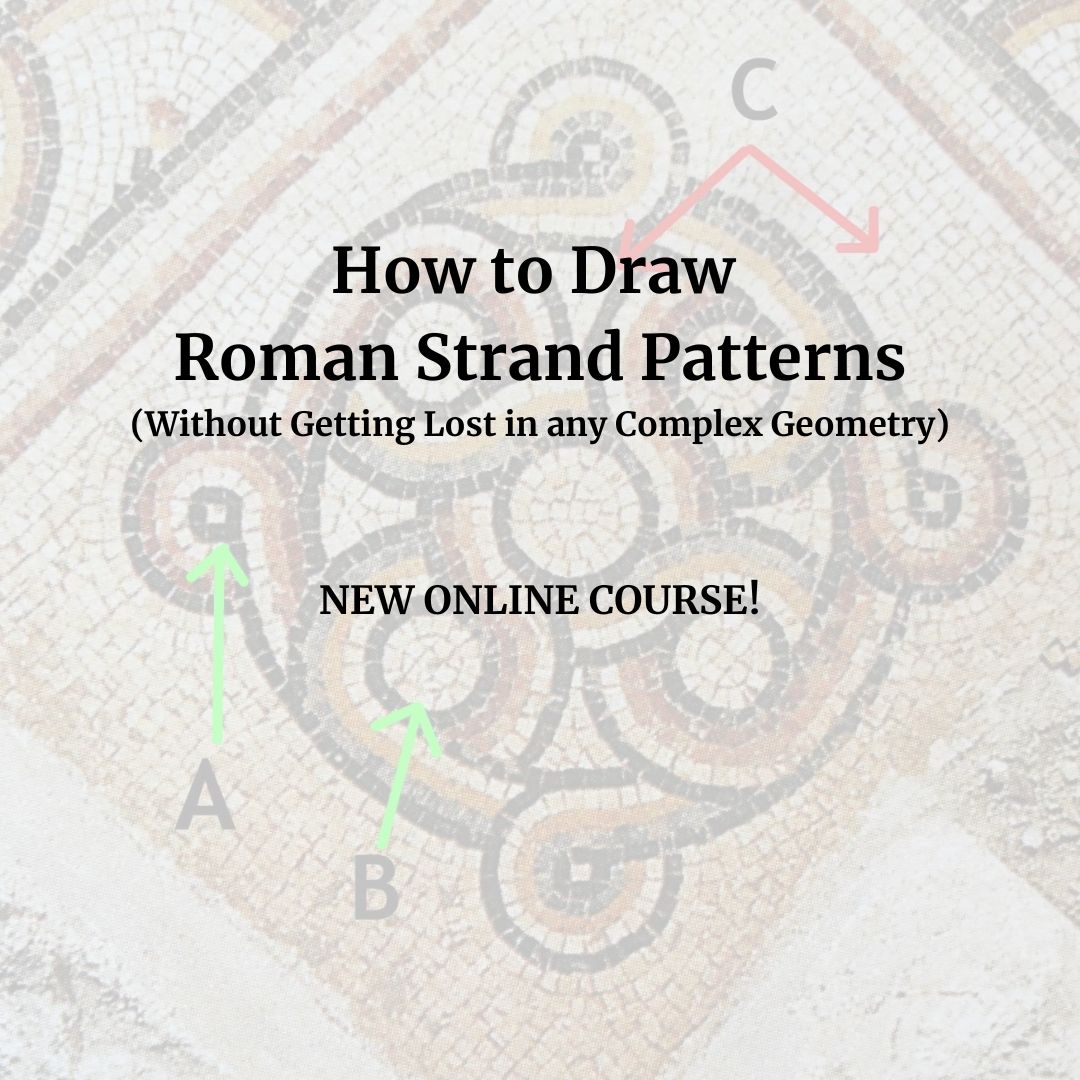
Stop Tracing Lines. Start Decoding the Patterns.
The Secret to Drawing Roman Strand Patterns (Without Getting Lost in Complex Geometry)
When you look at a Roman mosaic in a museum, or see complex strand patterns like Solomon’s Knot, it’s easy to think you need a degree in technical geometry to replicate them. Most people try to draw them by layering dozens of overlapping circles or complex lines on top of each other. It’s frustrating, it’s confusing, and it usually leads to a mess.
But that can just be confusing, especially if you don't have any background in technical drawing. This method is structure first, geometry second.
Years ago, I almost gave up on the strand patterns completely. I was staring at a complex border pattern, completely paralyzed. I honestly believed that the only way to understand those lines was to master complex geometry and technical drawing skills, and I was hopeless at that!
I wanted a system that would give me consistent, predictable success with every single pattern—from the simplest border to the most complex floor mosaic. So I created one.
This isn't just 'my take' on history; it’s a completely fresh, step-by-step approach designed to simplify the process. For example: Instead of seeing a Solomon’s Knot as a collection of five geometric circles, you will learn to see it for what it actually is: two interlocking chain links.
This is not a drawing trick — it’s a perceptual shift. Train your eye first, and the hand follows naturally. No more guesswork. No more fragile copies
The Golden Rule of This System:
Everyone starts at exactly the same place. Whether you are a total beginner who hasn't picked up a pencil since school, or an experienced artist who regularly draws Celtic knots, Mandalas, or Islamic art, this framework levels the playing field.
Step by Step Progression
This training is built on sequential mastery. Just like training a horse, we don't skip steps or just 'practice harder' when things go wrong.
If you get stuck on a complex pattern, the system shows you exactly how to step back to the previous pattern, check your structural understanding, fix the gap, and move forward with confidence. You never feel lost.
What do you get?
The Core Framework: Launching:
June 20th Live session at 10am (UK time)
July 19th 10am UK time.
Cant make these, there will be plenty more dates to go through live with me inside the community.
- The Digital Workbook: This is the core framework. It is not a massive, dry textbook. It is a lean, practical workbook designed for doing. You print it out, follow the steps, and get immediate results through drawing.
- Live sessions (recorded) with the dates added inside the group with sessions available on, 10th June, 20th June then 18th July. Scheduled to accommodate different time zones. All ofthem will be recorded and posted in the group.
- Access to the community from June 10th to meet others on the same learning journey, share you results and ask questions.
- A Living Library - Each week I will be adding videos of the full process for each of the 20+ patterns, both motifs and borders, highlighting what you need to note.
Start now and change the way you see these patterns forever.
Who am I?
I’m Lawrence Payne, and I’ve spent over two decades decoding Roman floor mosaics in museums, on commissions, and at archaeological sites. I've completed work in Europe and the UK, including supervising 117 square metres of Roman mosaic floors for the Villa Ventorum site in Somerset.
What previous customers have said;
Learn Roman Mosaics series manual
I so enjoyed working on the one I had tiles for. The instruction book in itself was worth the money I spent. I spent 200AU on a mosaic class and didn’t learn most of what was in that book.
Museum Guide
Lawrence Payne, I just read your e-book about Roman Mosaics--I learned so much! I love the clarity of the explanations, drawings and images--it is a treasure! I'm so glad I signed up for your newsletter!
Lawrence Payne
Who is Lawrence Payne?
Ever since I started this journey in 2002 I have been constantly looking for evidence of how those ancient mosaicists worked. I've gone over the mosaics and in making copies I feel I have a greater understanding of those craftsmen. Now I want to give you the chance to do this work for yourself.
Making small mosaics is no different from working on a full floor, you use the same method, the same outlook.